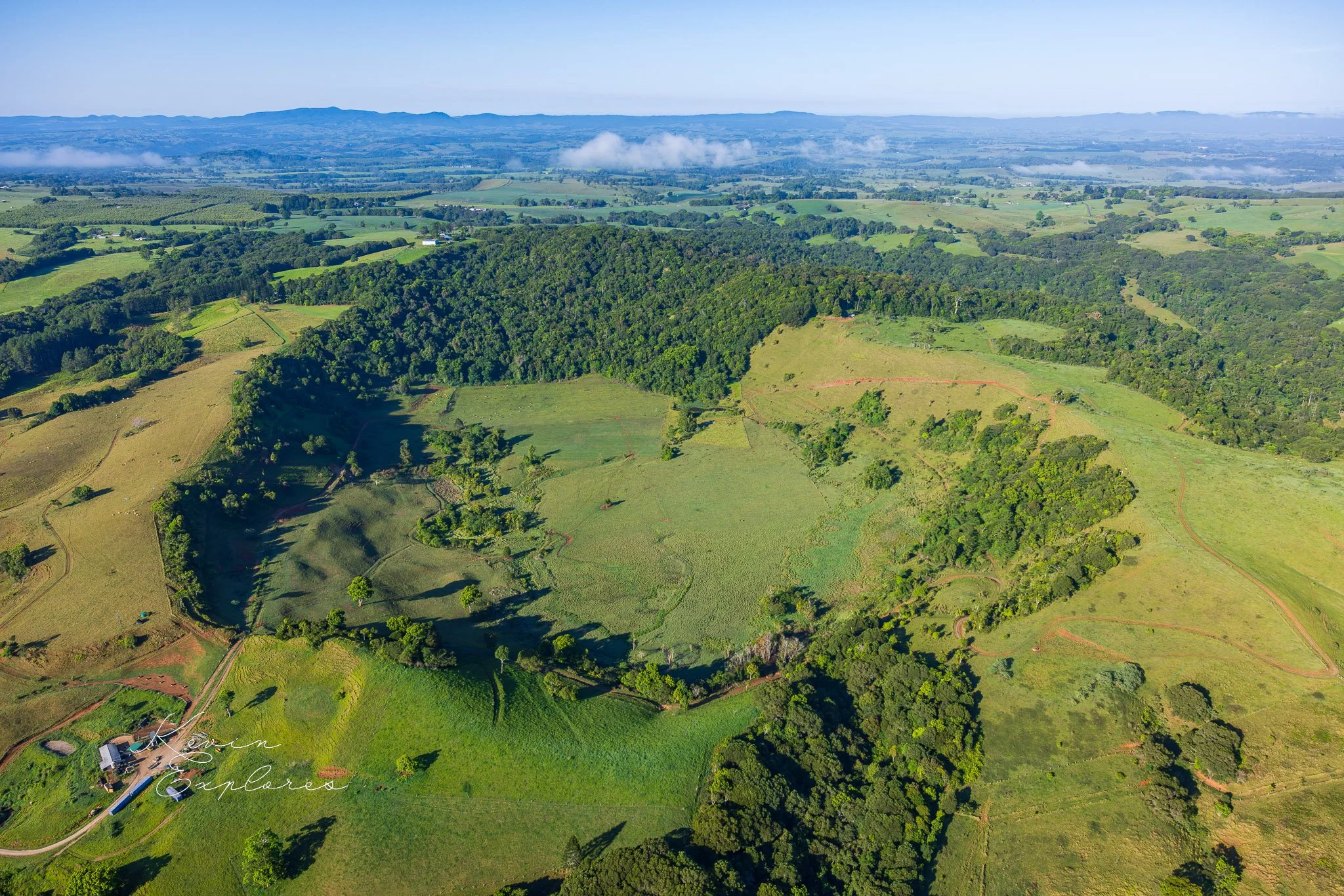
Aerial landscape interpretation reveals one of the Atherton Tableland's oldest volcanic features
Flying over the Atherton Tablelands, your eye naturally gravitates toward the familiar—Lake Eacham's perfect circular form, Lake Barrine's rainforest embrace, the steep cone of Mt Quincan. But nestled in the patchwork of cleared farmland and remnant forest on the tableland's eastern edge lies a less celebrated maar crater, one that holds secrets reaching back nearly 200,000 years.
Strenekoffs Crater doesn't appear in tourism brochures. You won't find walking tracks around its rim or swimming platforms on its waters. Yet from the air, this 650-metre-wide depression tells a story as dramatic as any in the region—a story of violent volcanic birth, climatic upheaval, and the patient accumulation of sediments that record environmental changes across multiple ice ages.
A Violent Beginning
Imagine this landscape 190,000 years ago. The tableland, already ancient in its granite foundations, experiences a surge of basaltic magma rising from the mantle. As the molten rock ascends, it encounters something that transforms a relatively benign volcanic event into catastrophe: groundwater.
The meeting is explosive. Superheated water flashes to steam faster than it can escape. Pressure builds to breaking point. Then—eruption. Not the leisurely lava flows that built shield volcanoes like Hallorans Hill, nor even the fire-fountain spectacle that created cinder cones. This is phreatomagmatic fury: steam-driven blasts that excavate rather than construct, sending volcanic bombs arcing through the air and leaving behind a gaping crater blasted into the bedrock.
The crater we see today from the air—that gentle depression in the landscape, softened by millennia of weathering and infill—was born in violence.
The Science of Silence
Here's where Strenekoffs Crater becomes intriguing from a scientific perspective, not for what we know, but for what remains uncertain. Unlike its neighbours Lake Eacham (dated to around 9,000 years) and Lake Barrine (approximately 17,000 years old), Strenekoffs has never been successfully dated by radiometric methods.
The reason lies in what geologists delicately term "complex stratigraphy." When researchers from Monash University, led by palynologist Peter Kershaw, drilled core samples from Strenekoffs in the early 1990s, they found sediment layers that were disturbed, mixed, or discontinuous. The neat chronological layering that makes nearby Lynch's Crater a paleoenvironmental goldmine simply doesn't exist here.
But science found a workaround. By comparing fossil pollen assemblages from the base of cores drilled at both Strenekoffs and Lynch's Crater, researchers could correlate the two sites biostratigraphically. The ancient pollen—microscopic grains preserved for hundreds of thousands of years—told the same vegetational story. The conclusion: Strenekoffs Crater likely formed during the same Middle Pleistocene volcanic episode as Lynch's Crater, placing its age at more than 190,000 years.
Think about that time depth. When Strenekoffs exploded into existence, anatomically modern humans had only recently emerged in Africa. Australia would remain unpeopled for another 140,000 years. Giant marsupials—Diprotodon, enormous kangaroos, marsupial lions—roamed a landscape that oscillated between rainforest and sclerophyll woodland as climate fluctuated through glacial cycles.
Reading the Aerial View
From the aircraft, what distinguishes a maar crater from other volcanic landforms? Several features become apparent:
The Depression: Unlike the constructional cones of shield volcanoes or scoria cones that rise above the surrounding terrain, maar craters are predominantly excavational. Strenekoffs sits as a broad, shallow bowl—70 metres deep originally, though centuries of sediment accumulation have partly filled it. The eye reads this negative space differently than the positive relief of a volcanic cone.
The Rim: Maar craters typically have a subtle rim of ejecta—the material blasted out during the initial explosion. At Strenekoffs, 190,000 years of erosion have subdued this feature, but from the right angle, the gentle elevation change around the crater's perimeter becomes visible, marked by the transition from cleared pasture to remnant forest.
Drainage Patterns: The crater's breach—where water overtopped the lowest point in the rim—has determined drainage for nearly 200 millennia. From above, you can trace how water moves across this landscape, following paths established when mastodons still walked the earth.
Land Use Patterns: The contrast between rich basaltic soils and the crater's infilled sediments often creates distinct vegetation or agricultural patterns visible from the air. These aren't random—they're a direct expression of the underlying geology, itself a product of ancient volcanism.
The Atherton Basalt Province Chronology
Strenekoffs Crater forms part of a remarkable volcanic province spanning 2,500 square kilometres and 7 million years. The Atherton Basalt Province contains 65 identified eruptive centres, each adding a chapter to the region's geological story.
The volcanic history here shows a clear progression:
7.1–2.8 million years ago: Large shield volcanoes erupted voluminous fluid lavas that filled valleys and built broad, gentle-sloped mountains. Jensenville and Malanda volcanoes typify this era, their flows extending tens of kilometres, some overflowing the Great Escarpment to cascade down to the coastal plain.
2.0–1.0 million years ago: A second pulse of shield volcano activity, though less voluminous than the earlier phase. Bones Knob, Lamins Hill, and Campbells Hill date to this period.
1.0 million years ago–present: The style changed dramatically. Instead of massive shields, the province produced smaller pyroclastic vents—cinder cones and maars. This shift signals fundamental changes in the magma supply and eruption dynamics. The province was waning, but in its decline, it created some of its most spectacular features.
Strenekoffs sits within this late phase, one of nine maar craters punctuating the tableland. These maars represent the province's final gasp—smaller volume eruptions, but no less dramatic in their violence.
The Lynch's Crater Connection
Understanding Strenekoffs Crater requires understanding its more famous neighbour. Lynch's Crater, just a few kilometres away, has become one of Australia's most important paleoenvironmental research sites, yielding a continuous pollen record spanning 230,000 years—one of the longest terrestrial records in the Southern Hemisphere.
From this single site, scientists have reconstructed:
Multiple glacial-interglacial cycles
The arrival of humans in Australia around 45,000–50,000 years ago
The extinction of Australia's megafauna
Aboriginal fire management practices spanning millennia
Climate oscillations driven by ice volume in the Northern Hemisphere
Sea level changes and their impact on regional rainfall
When Kershaw and colleagues drilled Strenekoffs, they hoped it might provide a parallel record. The complex stratigraphy dashed those hopes, but the biostratigraphic correlation it enabled remains valuable—it places Strenekoffs within the same ancient timeframe, expanding our understanding of volcanic activity during the Middle Pleistocene.
Interpreting Volcanic Landscapes from the Air
One of the privileges of aerial photography in this region is reading volcanic histories written in topography. Each volcanic landform has a distinctive signature:
Shield Volcanoes like Hallorans Hill display gentle, dome-like profiles—slopes typically less than 10 degrees that spread from a central high point. From above, they appear as broad swells in the landscape, their radial drainage patterns like wheel spokes.
Cinder Cones such as Mt Quincan show steeper sides (30-40 degrees) and more conical forms. Their craters are often preserved at the summit, visible as circular depressions.
Maars like Strenekoffs, Lake Eacham, and Lake Barrine present as nearly circular depressions with low surrounding rims. When water-filled, they're unmistakable—perfect circles in the landscape. When drained or infilled, they require a more trained eye to identify.
Diatremes like Mt Hypipamee are the most violent expression—narrow, deep craters blasted by gas-charged magma rising at velocities up to 10 metres per second.
Each form tells a story of eruption style, magma composition, and interaction with groundwater. Together, they map the evolution of the entire volcanic province.
The Soils Story
Flying over the patchwork of agriculture that now dominates the Atherton Tablelands, the connection between volcanism and land use becomes obvious. The rich, red basaltic soils weathered from ancient lava flows support dairy farming, coffee plantations, avocado orchards, and fields of maize. These soils—the legacy of volcanic activity stretching back millions of years—drew European settlers and sustain intensive agriculture today.
But they also drew Aboriginal people, who recognized the productivity of basaltic country and managed it with fire for potentially 50,000 years. The pollen record from Lynch's Crater shows a dramatic increase in charcoal around 45,000 years ago, coinciding with human arrival. This isn't random burning—it's evidence of systematic landscape management that maintained more open, productive vegetation.
From the air, you can still read this history. Remnant rainforest clings to the steeper slopes and crater rims—places that escaped both Aboriginal fire management and European clearing. The contrast between dense green rainforest and open pasture or crops maps directly onto topography and underlying geology.
Geodiversity and Heritage
The Atherton Tablelands represent one of Australia's most geologically diverse regions. Within a 50-kilometre radius, you can find:
Granite batholiths over 300 million years old
Metamorphosed Palaeozoic sediments
Basaltic shield volcanoes 3 million years old
Crater lakes less than 10,000 years old
Some of the world's oldest rainforest lineages growing on volcanic soils
Strenekoffs Crater contributes to this geodiversity. While it may lack the accessibility of Lake Eacham or the scientific renown of Lynch's Crater, it remains an important element of the region's geological heritage—a 190,000-year-old scar recording a violent moment in the Earth's geological story.
Fire, Forest, and Time
One pattern emerges consistently from paleoenvironmental research on the Atherton Tablelands: the intimate relationship between fire, forest, and climate. The landscape has oscillated between rainforest dominance during warm, wet interglacials and more open sclerophyll vegetation during cooler, drier glacials.
Fire acts as the agent of change. During drier periods, increased burning—whether from lightning strikes during intense dry seasons or from Aboriginal land management—converts rainforest to more fire-tolerant eucalypt woodland. When wetter conditions return, rainforest gradually reclaims the ground, but only if fire frequency decreases.
This dynamic has played out repeatedly over the 190,000+ years since Strenekoffs Crater formed. The landscape we see today from the air—a mosaic of remnant rainforest and cleared farmland—represents just the latest frame in a much longer film of environmental change.
What the Aerial View Reveals
From the ground, Strenekoffs Crater might be unimpressive—another depression in undulating terrain, overgrown with vegetation or converted to pasture. But altitude provides perspective. From the aircraft, patterns emerge:
The crater's circular form, though eroded and partly obscured, remains legible in the landscape. The breach in its rim has controlled drainage for geological ages. The surrounding topography—the product of older volcanic flows and basement granite—provides context. The distribution of forest versus cleared land maps onto soil types determined by underlying geology.
This is what aerial landscape interpretation offers: the ability to read geological time written in topography, to see how ancient processes—volcanic explosions 190,000 years ago, lava flows 3 million years old, tectonic forces that built mountains 300 million years ago—continue to shape human land use today.
Conservation and Interpretation
As pressure grows on the Atherton Tablelands—from agricultural intensification, climate change, invasive species, and development—the importance of conserving and interpreting geological heritage increases. The region's volcanic features tell stories that span from deep Earth processes through climate change and megafaunal extinction to Aboriginal land management and European settlement.
These aren't abstract academic concerns. Understanding the region's geological foundation helps us make better decisions about:
Water resource management in basalt aquifers
Soil conservation on volcanic landscapes
Maintaining remnant rainforest on different soil types
Planning for potential future volcanic hazards (the youngest eruptions may be only 7,000–10,000 years old)
Appreciating the deep time context within which human activity represents a fleeting moment
Strenekoffs Crater, even without tourist infrastructure or extensive scientific study, contributes to this understanding.
A Landscape in Layers
The view from the aircraft reveals what ground-level observation cannot: the layered nature of landscape. At Strenekoffs Crater and across the Atherton Tablelands, we see the accumulation of geological events:
300+ million years ago: Granite intrusions formed the basement, later exposed by erosion
7.1–0.01 million years ago: Basaltic volcanism repeatedly resurfaced the landscape
~190,000 years ago: Phreatomagmatic explosions created maar craters including Strenekoffs
50,000 years ago: Aboriginal people arrived and began systematic fire management
140 years ago: European settlement brought intensive land clearing and agriculture
Each layer remains legible in the landscape for those who know how to read it. This is the essence of landscape interpretation—recognizing that the present terrain represents an accumulation of processes operating across vastly different timescales.
The Question of Future Volcanism
One question visitors to the Atherton Tablelands often ask: could the volcanoes erupt again?
The geological evidence suggests volcanism here has waned but not necessarily ceased. The youngest dated eruptions (Lake Eacham at ~9,000 years, possibly younger undated centres) fall within the Holocene—geologically, the present. The gap since the last eruption isn't unusual for volcanic provinces with intermittent activity.
Aboriginal oral traditions record stories of volcanic eruptions and crater lake formation that align remarkably well with scientific dating. The Dyirbal people's stories of Lake Eacham, Lake Barrine, and Lake Euramoo describe events consistent with phreatomagmatic maar formation—suggesting eruptions witnessed by people.
From a geological perspective, the Atherton Basalt Province remains potentially active. The mantle processes that drove volcanism for 7 million years haven't fundamentally changed. Future eruptions are possible, though their probability and timing remain uncertain.
This adds another dimension to landscape interpretation. We're not just reading a static archive of past events—we're observing a landscape that retains the potential for dramatic geological activity.
Conclusion: Hidden in Plain Sight
Strenekoffs Crater reminds us that significance isn't always obvious. While tourists flock to Lake Eacham's swimming platforms and Lake Barrine's teahouse, Strenekoffs sits quietly in private farmland, its scientific potential recognized but not fully realized, its 190,000-year history known only to specialists.
Yet it's precisely these less celebrated features that often reveal the most about how landscapes work. Strenekoffs, with its complex stratigraphy, teaches us that not every volcanic crater becomes a perfect geological archive. The processes that disturb sediments—erosion, bioturbation, water level fluctuation—are themselves part of the landscape's story. The crater's difficult stratigraphy reflects 190,000 years of environmental dynamism, of wet periods and dry, of forest and grassland, of megafauna and eventually humans, all leaving their marks.
From the aircraft, Strenekoffs appears as a subtle depression in gently rolling country—easily overlooked. But knowing its story transforms the view. That circular form records an explosion that shook the earth nearly 200,000 years ago. Those sediments, however disturbed, accumulated grain by grain through multiple ice ages. That breach in the rim has channeled water along the same path for two thousand centuries.
This is what aerial landscape interpretation offers: the ability to see beyond surface appearance to the deep time processes that created what we see today. Every volcanic cone, every crater, every lava flow contributes to the narrative. Even the less celebrated features—especially the less celebrated features—add essential chapters to the story.
Strenekoffs Crater may not have tourism infrastructure or intensive scientific documentation, but it remains what it's always been: a window into deep time, hidden in plain sight on the Atherton Tablelands.
Explore More from the Air
Want to discover more hidden stories in North Queensland's landscapes?
The Atherton Tablelands and Cape York contain countless geological, ecological and cultural narratives waiting to be revealed from the air. From volcanic craters and granite tors to river systems that tell stories spanning millions of years, each flight uncovers new perspectives on how this ancient landscape continues to shape our present.
Follow Kevin Explores:
Instagram: @kevinexplores for regular aerial imagery and landscape insights
Website: kevinexplores.com.au for in-depth articles and expedition updates
Never miss an article:
Subscribe for email updates when new landscape interpretation articles are published. Head to the contact page and let me know you'd like to receive notifications of new posts. I'll send you updates on volcanic landscapes, river systems, geological deep dives, and aerial photography expeditions across Far North Queensland and beyond.
Whether you're interested in geology, natural history, landscape photography, or simply seeing familiar country through new eyes, there's always another story waiting to be told from altitude.
Kevin Explores combines aerial photography with geological, ecological and cultural landscape interpretation across North Queensland. For more stories of landscape and deep time, visit kevinexplores.com.au
Academic Papers:
Whitehead, P.W., et al. (2007). "Temporal development of the Atherton Basalt Province, north Queensland." Australian Journal of Earth Sciences 54:5, 691-709.
Kershaw, A.P., et al. (1991). "A comparison of long Quaternary pollen records from the Atherton and Western Plains volcanic provinces." In: The Cainozoic in Australia, pp. 288-301.
Kershaw, A.P., et al. (2007). "A complete pollen record of the last 230 ka from Lynch's Crater, north-eastern Australia." Palaeogeography, Palaeoclimatology, Palaeoecology 251:3-4, 23-45.
Online Resources:
Global Volcanism Program: Atherton Basalt Province
Geoscience Australia: North Queensland Volcanic Provinces
Queensland Museum: Atherton Tablelands Geology
Technical Note: Grid reference CA 619817 (UTM 55K, Australian National Spheroid, 1966). Crater dimensions: radius 650m, depth 70m. Classification: maar volcano. Age: >190,000 years (biostratigraphic correlation). Status: undated by radiometric methods.