Geological Abstracts — Prominent Hill
This is the first in a series of posts using satellite imagery to read the Australian landscape. What looks like abstract art usually turns out to be geology. Always turns out to be geology.
Look at the image for a moment before reading on.
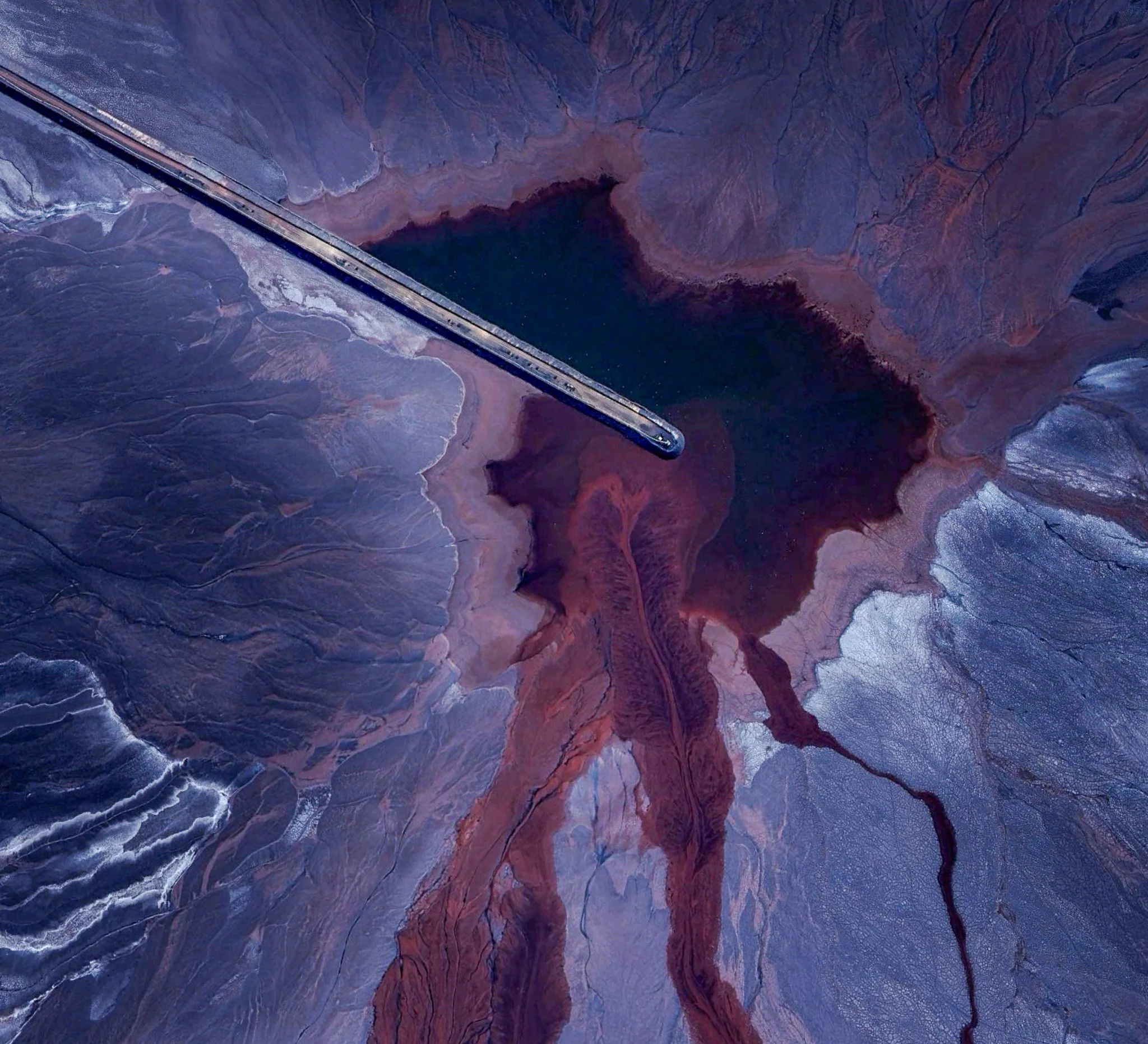
Prominent Hill Mine Tailings Dam, South Australia
The sweeping colour fields — purples, rusts, the deep black of still water. The diagonal line cutting across the frame like a brushstroke. The way the red bleeds into grey at the margins, the white streaks that could be frost or salt or light. If someone told you this was a contemporary painting, you'd have no reason to doubt them.
It isn't.
This is a tailings storage facility at Prominent Hill — one of Australia's most significant copper and gold mines, sitting in the South Australian desert 650 kilometres northwest of Adelaide and 130 kilometres southeast of Coober Pedy. The diagonal is a conveyor infrastructure crossing the impoundment. The dark pool is the tailings themselves: the crushed, processed residue of ore extraction. The colour palette isn't artistic licence — it's iron-stained regolith, the surface expression of one of the most ancient and mineralised geological terrains on the continent.
The image was taken from Google Earth. I've been using satellite imagery to scout geological stories from altitude, and this one stopped me cold.
What's being extracted, and why it's here
Prominent Hill is classified as an Iron Oxide Copper-Gold deposit — an IOCG, in the shorthand. The ore body contains copper, gold, and silver locked inside hematite-rich breccia: fractured, shattered rock cemented together by iron-oxide minerals and riddled with metallic sulphides. Chalcocite, bornite, chalcopyrite. The names don't matter as much as the story of how they got there.
About 1.59 billion years ago, a pulse of volcanic activity tore through what is now central South Australia. Magma welled up from depth — possibly driven by a mantle plume — and erupted as the Gawler Range Volcanics, a vast outpouring of lava and ash across hundreds of thousands of square kilometres. Heat from that magmatic event drove superheated fluids through the fractured crust. Those fluids carried dissolved metals — copper, gold, silver — and as they moved through the rock, they deposited their cargo in voids and breccia zones. The metals concentrated. The fluids cooled. The process stopped.
And then, for 1.6 billion years, essentially nothing happened.
The patience of the Gawler Craton
That's not rhetorical. The Gawler Craton — the ancient geological province that hosts Prominent Hill — has been tectonically inert since roughly 1.45 billion years ago. No mountain-building episodes. No significant compression or extension. The thick, cold, old lithosphere of the craton simply resisted deformation while the rest of the planet continued its geological business around it.
The craton covers roughly 440,000 square kilometres of South Australia. Its oldest rocks date to around 3.25 billion years. The surface above the ore body is a deeply weathered planation surface — flat, red, featureless — the result of billions of years of slow chemical breakdown and minimal physical erosion. It tells you nothing about what lies beneath.
That invisibility is almost the most remarkable thing about Prominent Hill. The deposit was discovered in 2001 — not by following a geological hunch to an outcrop or a stain in the soil, but by flying instruments over empty desert. Airborne magnetic surveys detected the iron-rich signature of the buried ore body. Gravity measurements confirmed a dense mass underground. There is no hill at Prominent Hill. The name came from the exploration tenement. The ore body sits between 100 and 1,462 metres below the surface, extending 2,600 metres east to west and 1,400 metres vertically. You cannot see it. You cannot feel it. Only the instruments knew it was there.
Part of a bigger story
Prominent Hill isn't alone. It sits within the Olympic Copper-Gold Province — a corridor of IOCG deposits along the eastern margin of the Gawler Craton that includes Olympic Dam (roughly 200 kilometres to the southeast) and Carrapateena (250 kilometres southeast). All three formed in the same volcanic episode, driven by the same magmatic heat, within a few tens of millions of years of each other.
Before Prominent Hill was drilled, Olympic Dam was considered a geological anomaly — too large, too unusual to be a template for anything else. Prominent Hill proved the system was repeatable. The Gawler Craton had been hiding multiple world-class ore bodies beneath its featureless surface all along.
The mine above them, from altitude, looks like a painting.
Deep time, extracted.
Image: Google Earth
Never miss a post by subscribing at Substack and reading past posts on my blog.